The crash of wheat prices in 1929 was followed in 1931 by one of the worst droughts that the Great Plains had seen in over a hundred years. With no visible sources of water, farmers were forced to let their fields lie fallow. The suitcase farmers abandoned their lands, leaving millions of acres of plowed-up dirt open to the elements. When the high winds whipped across the prairie they began to pick up immense clouds of dust, which turned into dust storms that tore through towns and destroyed homes and crops. As the dust storms continued farmers' lives were in danger, as the dust filled their homes and their lungs. Over the next 8 years the drought continued, threatening to turn most of western Oklahoma into the Sahara Desert. After starving and nearly losing their land many farmers began to do the unthinkable--ask the federal government for assistance. Amazingly, the same man whose policies had created the Dust Bowl by arbitrarily fixing a high price for wheat, Herbert Hoover, was now President of the United States; but he would have nothing to do with helping the farmers.
Angered by Hoover's policies the nation elected Franklin Roosevelt, who was specifically elected on a platform the use the intervention of the federal government to aid the victims of the Great Depression and the Dust Bowl. He dispatched federal agents to the Great Plains, having them buy up and destroy surplus livestock and crops (what little there was left) to create a scarcity and drive up prices. He also issued the first-ever farm subsidies, which paid farmers federal money for not growing crops. He ordered banks to issue loans to farmers for new equipment. For many victims of the Dust Bowl this was the first income they had seen in nearly a decade. However, his policies led to an increasing number of farmers continuing to take farm subsidies. Also, most farmers could not function without living in debt to banks and loan agencies. Consequently, U.S. farmland has been transformed into being nearly entirely dependent on the federal government for survival.
Showing posts with label politics. Show all posts
Showing posts with label politics. Show all posts
Tuesday, May 21, 2013


Thursday, May 16, 2013
Plowing up the Plains
The idealism that was a hallmark of 19th century Victorianism came to an abrupt end with the beginning of World War I. In 1917 a businessman named Herbert Hoover was appointed head of the U.S. Food Administration, which was charged with stabilitizing U.S. food prices during the war. As head of the administration Hoover created the first ever federally-controlled price limits on produce, effectively turning food into a commodity. Up until this time Russia was the largest supplier of European wheat, but because of the war front, their farmers could not sell their produce. Hoover wanted the U.S. to take over this market, and by artificially fixing a high price for wheat, U.S. farmers began planting lots of it. Millions of acres in the central United States, espeically the plains of newly-settled Oklahoma, were plowed under for wheat. This entire region, which had once been a dry grassland, was plowed up to make room for more wheat. Wheat became so profitable that it led to the rise of "suitcase farmers," wealthy businessmen from the East Coast who would buy up land in Oklahoma and pay someone else to farm the land for them. They bought up huge tracts of land, radically transforming the landscape of the Great Plains. Hoover, meanwhile, won an humanitarian award for sending money to the starving Russian farmers that his economic policies put out of business.
Eventually, even in the U.S., the prosperity grown on wheat came to an end. In 1929 the stock market crashed and the price of all commodities plummeted. Farmers in the Great Plains continued to produce wheat, even when the price dropped below the cost of planting. Since the price of wheat dropped, they just plowed up more land to plant more wheat, increasing the economic damage that was to come. There was so much wheat that much of the stores rotted before they could be transported, and much of it was burned. While unemployed workers and broke businessmen in the cities were starving, farmers in the Great Plains were burning their excess wheat crops because there were no trains to take them to market.
Without a source of income most farmers turned to subsistence farming, keeping their families alive with what they could produce in their own gardens at home. That, however, changed when the Dust Bowl began.
Eventually, even in the U.S., the prosperity grown on wheat came to an end. In 1929 the stock market crashed and the price of all commodities plummeted. Farmers in the Great Plains continued to produce wheat, even when the price dropped below the cost of planting. Since the price of wheat dropped, they just plowed up more land to plant more wheat, increasing the economic damage that was to come. There was so much wheat that much of the stores rotted before they could be transported, and much of it was burned. While unemployed workers and broke businessmen in the cities were starving, farmers in the Great Plains were burning their excess wheat crops because there were no trains to take them to market.
Without a source of income most farmers turned to subsistence farming, keeping their families alive with what they could produce in their own gardens at home. That, however, changed when the Dust Bowl began.
Tuesday, May 7, 2013
Communism and Evolution
The unfamiliarity with the land, and consequent fear of destroying it, characterized much of the cultural reactions to the Industrial Revolution. This is seen in Romanticism, but also in the political movement of Communism. Much of Communism was in direct contradiction with not only the agrarianism that had undergirded society for thousands of years, but also with the political thought of the Englightenment, especially John Locke's writings on private property and the importance of labor. As a result of Darwin's Theory of Evolution, the Communists desired a completely materialistic interpretation of history, one stripped of any gods, heroes, or villains.
Frederick Engels, a close friend of Karl Marx, wrote The Origin of the Family, Private Property and the State in 1884 to create a historical justification for Communism. He argued that man's original communities existed of small, matriarchal tribes that held all women, children, and property in common. This became the ideal to which Communists desired to return. He argued that Greek city-states contained the origins of private property and that ancient despots set themselves up as kings over and against these matriarchal tribes. He believed that these petty kings retained land for themselves which was the origin of private property. Consequently, he also believed that our idea of a nuclear family only came about to provide some means of inheritance to the king's property.
Engels had no substantial historical backing for most of his claims, however, that would not stop them from being used to provide the foundation for nearly every 20th century metanarrative: from Darwinian evolution to modern feminism and socialism. Evolutionary biology can even be seen in the transformation of land ownership from "husbandry" to "agricultural science." This reinterpretation of a relationship to one of science-ism also reinterprets the world materialistically and into one without reference to human interaction.
Frederick Engels, a close friend of Karl Marx, wrote The Origin of the Family, Private Property and the State in 1884 to create a historical justification for Communism. He argued that man's original communities existed of small, matriarchal tribes that held all women, children, and property in common. This became the ideal to which Communists desired to return. He argued that Greek city-states contained the origins of private property and that ancient despots set themselves up as kings over and against these matriarchal tribes. He believed that these petty kings retained land for themselves which was the origin of private property. Consequently, he also believed that our idea of a nuclear family only came about to provide some means of inheritance to the king's property.
Engels had no substantial historical backing for most of his claims, however, that would not stop them from being used to provide the foundation for nearly every 20th century metanarrative: from Darwinian evolution to modern feminism and socialism. Evolutionary biology can even be seen in the transformation of land ownership from "husbandry" to "agricultural science." This reinterpretation of a relationship to one of science-ism also reinterprets the world materialistically and into one without reference to human interaction.
Friday, October 26, 2012
Faith
This week it struck me that every day God feeds people, clothes people, and puts a roof over our heads, not to mention provides a myriad of other daily blessings which constantly surround us; He does this for both Christian and pagan alike, and yet we struggle to have faith in Him.
On the other hand, people put so much faith in politics, yet when was the last time the President did anything for you?
On the other hand, people put so much faith in politics, yet when was the last time the President did anything for you?
Tuesday, October 16, 2012
You Think You Have it Bad
I am about halfway through a wonderful book, that I only started 2 days ago. It's a history of the Dust Bowl by Timothy Egan called The Worst Hard Time. Very few histories of this time have yet been written, and most likely because the survivors refuse to talk about it. The author asked one gentleman, now in his 90s, for an interview because he had kept a daily diary of this part in his life. The survivor agreed, but then shortly saw his wife burning the diary in the fireplace. When he asked her why she responded, "nobody needs to hear about that time. It was too horrible to talk about."
 He tells an excellent history, most of which I had never known before. For example, during World War I the Russians were not able to supply Europe with wheat, because of the fighting. As a consequence, the U.S. secretary of Agriculture, who was Herbert Hoover, set up the first-ever government price-fixing on wheat to encourage Americans to grow more of it. He set the price unnaturally high ($2.00 per bushel at that time), and everyone started plowing for wheat. Ranchers converted to wheat farmers, farmers planted entire crops in wheat, even big city types bought farms in Oklahoma, just to plow and plant in wheat fields. Of course the market was soon glutted, and after the stock market crash of 1929 the price of wheat fell to 20 cents per bushel--less than half the cost of growing it.
As a result, farmers couldn't afford to plow their fields while piles of wheat rotted in barns and at the railroad station. By this time Herbert Hoover was now president and refused to offer government assistance, because he wanted the free market to fix the problem of the wheat surplus. The same Herbert Hoover who caused the problem 10 years earlier by government intervention in the market.
The early 1930s brought one of the worst droughts the High Plains had seen in a long time, and since farmers couldn't afford to farm, acres and acres of farmland was left exposed to erosion. This created the Dust Bowl, which at one point destroyed 13 million of the 16 million acres of farmland in Oklahoma (not to mention the surrounding states).
Most of these High Plains settlers lived in dugout homes, which were essentially holes dug straight into the prairie. One family of 7 had to share just over 500 square feet of living space. Although the stock market crash ruined the farmers' finances, most could still subsistence-farm and grow enough food for their own family, until the Dust Bowl hit. Once the land was destroyed, the farmers also began to starve. One family with 4 children said they each had their "Dinner Night." There was only enough food to have one family member eat dinner each night, so they rotated, and once every 4 nights you got to eat. The worst hard time is certainly a fitting name.
He tells an excellent history, most of which I had never known before. For example, during World War I the Russians were not able to supply Europe with wheat, because of the fighting. As a consequence, the U.S. secretary of Agriculture, who was Herbert Hoover, set up the first-ever government price-fixing on wheat to encourage Americans to grow more of it. He set the price unnaturally high ($2.00 per bushel at that time), and everyone started plowing for wheat. Ranchers converted to wheat farmers, farmers planted entire crops in wheat, even big city types bought farms in Oklahoma, just to plow and plant in wheat fields. Of course the market was soon glutted, and after the stock market crash of 1929 the price of wheat fell to 20 cents per bushel--less than half the cost of growing it.As a result, farmers couldn't afford to plow their fields while piles of wheat rotted in barns and at the railroad station. By this time Herbert Hoover was now president and refused to offer government assistance, because he wanted the free market to fix the problem of the wheat surplus. The same Herbert Hoover who caused the problem 10 years earlier by government intervention in the market.
The early 1930s brought one of the worst droughts the High Plains had seen in a long time, and since farmers couldn't afford to farm, acres and acres of farmland was left exposed to erosion. This created the Dust Bowl, which at one point destroyed 13 million of the 16 million acres of farmland in Oklahoma (not to mention the surrounding states).
Most of these High Plains settlers lived in dugout homes, which were essentially holes dug straight into the prairie. One family of 7 had to share just over 500 square feet of living space. Although the stock market crash ruined the farmers' finances, most could still subsistence-farm and grow enough food for their own family, until the Dust Bowl hit. Once the land was destroyed, the farmers also began to starve. One family with 4 children said they each had their "Dinner Night." There was only enough food to have one family member eat dinner each night, so they rotated, and once every 4 nights you got to eat. The worst hard time is certainly a fitting name.
Friday, October 12, 2012
I am Rich.
Republicans want what's best for the middle class. Democrats want what's best for the middle class. This argument continues on the same issue, ad nauseum. This may sound repetitive, since I was posted on this here, but there is no middle class.
The Bible talks about the rich and the poor. What we call the "middle class" is just an excuse for rich people, who aren't as rich as other rich people, not to have to call themselves rich. Considering the fact that "middle class" people in the United States usually own their house, a couple of cars, three healthy meals a day (at the very least), and a closet full of clothes to wear, means that they are wildly wealthy compared to most of the world today, and even most people throughout history. If you cling to the label "middle class," then you can excuse yourself from all the Bible verses that exhort and challenge the rich, especially in regards to their obligation to provide for the poor and be generous with their blessings, because of course that's not you--that's the guy down the street who owns a nicer house with cooler cars.
There is no doubt that healthy societies are those that have a small disparity between the living conditions of the very rich and the very poor, which is what contributes to the idea of the middle class. But in our current political climate this guise of "helping" the middle class, just promotes the idea that everyone needs the government's help. The middle class needs the government's help and the poor need the government's help. Who should complain when the corporation CEO decides that he, too, wants in on the government's help?
The Bible talks about the rich and the poor. What we call the "middle class" is just an excuse for rich people, who aren't as rich as other rich people, not to have to call themselves rich. Considering the fact that "middle class" people in the United States usually own their house, a couple of cars, three healthy meals a day (at the very least), and a closet full of clothes to wear, means that they are wildly wealthy compared to most of the world today, and even most people throughout history. If you cling to the label "middle class," then you can excuse yourself from all the Bible verses that exhort and challenge the rich, especially in regards to their obligation to provide for the poor and be generous with their blessings, because of course that's not you--that's the guy down the street who owns a nicer house with cooler cars.
There is no doubt that healthy societies are those that have a small disparity between the living conditions of the very rich and the very poor, which is what contributes to the idea of the middle class. But in our current political climate this guise of "helping" the middle class, just promotes the idea that everyone needs the government's help. The middle class needs the government's help and the poor need the government's help. Who should complain when the corporation CEO decides that he, too, wants in on the government's help?
Monday, March 26, 2012
Chesterton 2012
"It may be said with rough accuracy that there are three stages in the life of a strong people. First, it is a small power, and fights small powers. Then it is a great power, and fights great powers. Then it is a great power, and fights small powers, but pretends that they are great powers, in order to rekindle the ashes of its ancient emotion and vanity. After that the next step is to become a small power itself."
--G.K. Chesterton from Heretics
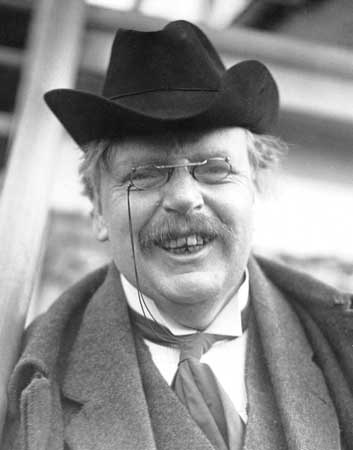 Well, here's to hoping. Maybe if Ron Paul gained a couple of hundred pounds and stopped brushing his teeth we might get close.
--G.K. Chesterton from Heretics
Friday, March 16, 2012
Father Hunger and Patriotism
 "The great gap in his mind is what may be roughly called the lack of patriotism.....He admires England, but he does not love her; for we admire things with reasons, but love them without reasons."
---G.K. Chesterton on Rudyard Kipling from Heretics
Last week I read this line and began to mull over what Chesterton means. He criticizes Kipling for not truly loving his country, but only liking his country. He likes England because she has a strong military or because he likes the current prime minister. However, you don't need to give reasons for why you love your child, or spouse, or parent. Even if your child disobeys you, you still love them. However, you prove your lack of love if you give up on someone when they don't do what you like.
This b
 eing an election season, I began to see this everywhere in our current right-wing, left-wing politics. The right-wing likes America because we have a strong military, or conservative economics, or moral values. The left-wing likes America because of our democracy, or public education, or socialized medicine (in progress). Why do they argue so intensely over these platforms? And why do I always have the sneaking suspicion that although they pretend to be opposed to each other, they are really quite similar? If Chesterton is correct, then neither side shows true patriotism. They fight viciously for their platforms because they are afraid of not liking America any longer.
It is hard to find true patriots these days. But just like loving your family, loving your country doesn't mean that everything it does is righteous. You love your own father because he is your father, but if your father is destroying his family you have a Christian obligation to love him by pointing this out to him. The Latin root of "patriot" is literally someone who loves their father, and this country is our fatherland. Because examples of godly fatherhood in our country are rapidly disappearing, we should not be surprised that true patriotism is also hard to find. The healthy, irrational loyalty that is inspired in a family by a faithful father is the kind of loyalty we should also have for our country, which is patriotism. This is not "my country right or wrong," or "my country, as long as I get my say," but "I love my country, so she may not do that."
Wednesday, March 14, 2012
The Government Should Stay Out of My Safeway
 I recently finished reading the book The Omnivore's Dilemma by Michael Pollan. I know this is a bit out of date, as the book came out several years ago, but that's just because I'm slow. I finally decided to read this one for two reasons: first, I had seen Pollan interviewed several times on different food documentaries. Most of these documentaries were full of fire-breathing organic-ists, but Pollan always sounded surprisingly sane. Secondly, I know some people who became fire-breathing organic-ists after reading this book, so I wanted to be able to find out how that happened.
Here is where I was coming from. "Organic" is a word that certainly doesn't mean what it really means anymore. I used to ask my students what organic meant, in my biology class, and they would answer "without chemicals," or "no pesticides." They never believed me when I told them it just meant "life" and consequently they did pretty poorly on their tests. It also makes ridiculous the idea of "inorganic food." This was probably the first thing to bias me against the organic movement. Also, although I love the way good food tastes--and usually the more local, the better--I despise the elitism that goes with words like "organic," "free-range," or "natural." Most of the elitists show disdain for the poor and lack of gratitude for the food God made.
Pollan divides his book into 4 different meals, and describes how those meals arrive at our table. His first meal is one made fully from industrial agriculture (and he visits McDonalds for dinner at the end). His second meal is what he calls "Big Organic." For this meal he buys everything from Whole Foods. His third meal is a pure, free market meal, which he calls, "Greetings from the Non-Barcode People." In this chapter he visits the farm of Joel Salatin, a well-educated, multigenerational, Baptist-preacher/farmer, and eats with his family. His last meal is the Hunter/Gatherer meal, where he hunts his own wild boar and makes the meal with things he finds in the woods or grows himself (lettuce, wild mushrooms, sourdough bread, etc.).

He actually does a wonderful job, whether he intends to or not, of demonstrating that our entire "industrial" food system is the result of government subsidies. Our government subsidizes the growing of corn. As a result, thousands of local farmers have gone out of business because they haven't been allowed to sell their product for what it is worth. Also, this has led to a surplus of corn that we need to use; which has created the feedlot-style system of raising farm animals.
God made cows to eat grass, but we feed them corn. Because their guts don't digest corn well, we need to give them antibiotics to help them fight infection. We also have to fatten them quickly, so they can be butchered before they die at a young age. Also, corn doesn't contain the correct fatty acids for their bodies, so we grind up other cattle bones and fat for them to eat--turning our cows into cannibals. This also necessitates the need for more antibiotics to guard against mad-cow disease (what happens to cows when they eat other cows). The same system is in place for feeding chickens (and yes, they feed dead chicken parts back to the chickens also).
 Pollan was also surprisingly moderate on the organic movement. He does a wonderful job of attacking what he calls "Big Organic," such as the Whole Foods empire and organic regulatory groups. He does a wonderful job of describing the quaint farm picture of the free-range chickens at Whole Foods, and then he actually goes and visits that farm. It turns out that free-range chickens are no different from regular chickens--as California law only forces them to "have access to the outdoors." This means that the free-range chickens are raised in the same massive silos as the other chickens, but there is a small slit door in the bottom corner of the silo that leads out to a narrow strip of grass that runs part-way down the edge of the silo. Since these are also "organic" chickens, the chicks don't receive any antibiotics, so they are not actually allowed to even use this outside option until they're old enough to ignore it. In his visit to this particular organic, free-range chicken farm he never saw even one chicken get close to using their free-range option.
The most entertaining farmer he visited was, without a doubt, Joel Salatin. Besides the fact that I enjoyed seeing Pollan, who is a Berkley professor and liberal Jew, loving his time with this fundamentalist Baptist (he graduated from Bob Jones University), who even has a fish sign on his front door; Salatin is a really fun guy. He inherited his farm from his father, who worked on the farm over weekends and holidays, all with the goal in mind of passing it on to his son who could hopefully support his family solely by farming. He describes himself as a "Christian-libertarian-environmentalist-capitalist-lunatic-Farmer," and he sees the root of all farming problems and food-price problems in our country as a result of government regulation. He does not consider himself an "organic" farmer, per se, but insists that if you understand the growth and behavior of animals and plants you don't need much pesticides, fertilizers, or other chemicals. His prices are affordable and reasonable (his chickens sell for $1.99/lb.). He also lives in West Virginia and refuses to ship his food farther than 150 miles from his home--but he insists that if the government got out of the farming business, there would be many more farmers just like him. I'm interested in reading his book called Everything I Want to do is Illegal.

Good food is a good thing. Sometimes, I believe, Christians give up the realm of tasty food to liberals, and it's not because we like food too much; it's usually because we like food too little. The Lord's Supper is bread and wine, two of the most developed tastes imaginable. The organic elitists are truly nauseating, but the realization that most of their food complaints are the results of government regulation was truly eye-opening. God gave us taste buds and a world that is edible, and the difference between a tomato we grew in our backyard and one that came on an airplane from South America a week ago (and was picked a week before that) is certainly noticeable. However, even though I was impressed at how much Pollan connected food problems in our country to government regulation, I have actually seen him in documentaries calling for more regulation as a solution. Hopefully more guys like Salatin will be able to make a living at farming, as there is certainly plenty of farmland out there (if only the government would leave it alone and let people use it)!
Monday, March 12, 2012
Who is my Neighbor?
Let's pretend, for a moment, that you have two neighbors. On one side, there is a father that you are pretty sure does a poor job supplying for his family. He calls in sick to stay home and watch ESPN, his kids are disorderly, and his wife looks like a mess. You know that one of these days he's going to get fired, and then his family could, quite possibly, starve.
Your neighbor on the other side, at this very moment, is standing in the front yard pointing a loaded rifle at his toddler.
I don't think it takes very much thought process to determine which of these two demands your immediate attention.
However, now imagine that instead of being home to see this travesty, you are away at work this morning, and a bystander is walking by on the sidewalk. He lives nearby, and has seen the messy state of the lazy neighbor's yard, and can probably figure out that the man there doesn't take care of his family. However, at this very moment, he can also see the other father in the front yard, ready to blow his son away. Now this bystander takes quite a different opinion. He thinks it's good for fathers to have the option of killing their children, and, in fact, gives money to fathers who do this sort of thing. So he puts a few dollars in the murderer's pocket and strolls on. When he comes to the lazy neighbor's yard, he decides that he's had enough. He marches right up the walk, tears open the door, and walks in, demanding that it's high time for this man to get a job or his family will starve.
Now, even though you agree with the bystander as to the state of the lazy man's home, there's still no doubt that he has some serious issues with proportion and morality. After you come home and have a talk with the police, you may be able to have a decent discussion with him about standards and the value of human life. He may be intelligent and decent, just seriously confused. Maybe he doesn't know what guns do. Maybe he doesn't know what toddlers are. However, is that the kind of man that you would elect to run your own family? How about your church? How about your country?
Now imagine this bystander is also running for office in a local election. Even though you agree with him about your lazy neighbor, and that something should be done about him, how do you trust him when he simultaneously encourages fathers to murder their own children?
Your neighbor on the other side, at this very moment, is standing in the front yard pointing a loaded rifle at his toddler.
I don't think it takes very much thought process to determine which of these two demands your immediate attention.
However, now imagine that instead of being home to see this travesty, you are away at work this morning, and a bystander is walking by on the sidewalk. He lives nearby, and has seen the messy state of the lazy neighbor's yard, and can probably figure out that the man there doesn't take care of his family. However, at this very moment, he can also see the other father in the front yard, ready to blow his son away. Now this bystander takes quite a different opinion. He thinks it's good for fathers to have the option of killing their children, and, in fact, gives money to fathers who do this sort of thing. So he puts a few dollars in the murderer's pocket and strolls on. When he comes to the lazy neighbor's yard, he decides that he's had enough. He marches right up the walk, tears open the door, and walks in, demanding that it's high time for this man to get a job or his family will starve.
Now, even though you agree with the bystander as to the state of the lazy man's home, there's still no doubt that he has some serious issues with proportion and morality. After you come home and have a talk with the police, you may be able to have a decent discussion with him about standards and the value of human life. He may be intelligent and decent, just seriously confused. Maybe he doesn't know what guns do. Maybe he doesn't know what toddlers are. However, is that the kind of man that you would elect to run your own family? How about your church? How about your country?
Now imagine this bystander is also running for office in a local election. Even though you agree with him about your lazy neighbor, and that something should be done about him, how do you trust him when he simultaneously encourages fathers to murder their own children?
Thursday, December 1, 2011
Stealing

I've known for a long time that the government does stupid things. I've known for a long time that social programs like medicare and social security and income tax are foolish and wasteful, but up until now, I've realized recently, all that knowledge was up in my head, not connected to the real world except for the random news story.
For the last three years we've been involved in starting our school, and my eyes have been opened more and more to how the IRS deals with employers, as opposed to employees, but this week I think I've seen the worst example of just plain stealing.
Our school received a letter from the IRS that based on last year's tax amounts, next year we'll have to owe twice as much in employee taxes (not sure how they came up with that idea). Anyway, based on that tax level our school needs to file employee taxes monthly instead of quarterly, and if we don't, we will be fined. The only way to remedy this situation is to actually call the IRS (no e-mails or faxes are allowed here), be on hold for half the day, and hopefully find a thoughtful, compassionate IRS agent (heh, heh, heh) who will listen to your explanation that their estimate is a complete lie and fabrication, and please let us keep filing quarterly.
So I set out to do that today, and guess what? The IRS answering system is broken and they won't be receiving any calls. The answering system is at least able to say, "Please call back at another time and try again."
Monday, October 24, 2011
Tuesday, August 30, 2011
I Wish We Had More Politicians
I am currently reading the autobiography of my new presidential hero, Calvin Coolidge. He had a hard life, but probably had more integrity than nearly all of our current politicians combined. He was named after his father, John Calvin Coolidge, and he named his two sons John and Calvin. Talk about some serious Puritan roots.
This is what he said about the presidency:
"It is a great advantage to a President, and a major source of safety to the country, for him to know that he is not a great man. "
Now if we could only get more politicians like that, I wouldn't mind having a few more around.
This is what he said about the presidency:
"It is a great advantage to a President, and a major source of safety to the country, for him to know that he is not a great man. "
Now if we could only get more politicians like that, I wouldn't mind having a few more around.
Tuesday, February 1, 2011
Good News in the Middle East
So if Egypt and Tunisia sound like the last place you want to be, check out this that happened this past week. Of course, it is barely mentioned on major news networks. Southern Sudan is nearly entirely Christian, while the north is predominantly Muslim.
Wednesday, November 17, 2010
Our Own Personal TSA Nightmare
In light of everyone recently realizing how scary the TSA full-body scanners and pat-downs are, here's a little story about what happened to us this summer.
We were flying out of White Plains, NY airport back home to the west coast. My 4-year-old would like to be a farmer when he grows up, so he likes to wear his overalls. Having no idea of the nightmare we were in for by letting him do so, he wanted to wear his overalls on the airplane.
Going through the metal detectors, my husband and I split up--he took the 6-year-old through and I took the 4-year-old. Of course, the metal straps on his overalls caused the metal detector to go nuts. The attendant instructed him to go to a waiting area to be "wanded," and told me that I could wait with him.
When the next attendant arrived, he told me that both myself and my son were going to need a full pat-down! I was now a suspect, because I had "touched my son's hand while in the waiting area." My husband saw the commotion, and my refusal to comply, and came over to argue our case. The TSA supervisor was called to say that if we refused a pat-down then we could all "find another mode of travel." We were outraged. My husband insisted that we would neither be pat-down, nor would we leave the area. We are all for catching terrorists, but how on earth does a pat-down of a 4-year-old who's wearing overalls aid in catching criminals? The TSA supervisor stated that it was all just to assure the other passengers that they were "safe." "For goodness sake!" I cried, "How would a pat-down of a 4-year-old make me feel safe? That makes me more scared to fly!"
Basically by being difficult and insisting on our rights they finally just gave in and let us go, thank God. While sitting in the waiting area, trying to calm down we heard the following announcement made by the flight attendants, "Mr. Saladin...Mr. Saladin...would you please board your plane immediately for Washington, D.C." Hmmm...and you went after the 4-year-old in overalls, instead of Mr. Saladin heading to the capitol building?
We were flying out of White Plains, NY airport back home to the west coast. My 4-year-old would like to be a farmer when he grows up, so he likes to wear his overalls. Having no idea of the nightmare we were in for by letting him do so, he wanted to wear his overalls on the airplane.
Going through the metal detectors, my husband and I split up--he took the 6-year-old through and I took the 4-year-old. Of course, the metal straps on his overalls caused the metal detector to go nuts. The attendant instructed him to go to a waiting area to be "wanded," and told me that I could wait with him.
When the next attendant arrived, he told me that both myself and my son were going to need a full pat-down! I was now a suspect, because I had "touched my son's hand while in the waiting area." My husband saw the commotion, and my refusal to comply, and came over to argue our case. The TSA supervisor was called to say that if we refused a pat-down then we could all "find another mode of travel." We were outraged. My husband insisted that we would neither be pat-down, nor would we leave the area. We are all for catching terrorists, but how on earth does a pat-down of a 4-year-old who's wearing overalls aid in catching criminals? The TSA supervisor stated that it was all just to assure the other passengers that they were "safe." "For goodness sake!" I cried, "How would a pat-down of a 4-year-old make me feel safe? That makes me more scared to fly!"
Basically by being difficult and insisting on our rights they finally just gave in and let us go, thank God. While sitting in the waiting area, trying to calm down we heard the following announcement made by the flight attendants, "Mr. Saladin...Mr. Saladin...would you please board your plane immediately for Washington, D.C." Hmmm...and you went after the 4-year-old in overalls, instead of Mr. Saladin heading to the capitol building?
Wednesday, September 15, 2010
I Wish Ron Paul was My Doctor
Yesterday I read one of the best articles I ever have on being Pro-Life. This was a "mini" book (40 pages) written by Ron Paul way back in 1983, when legalized abortion was just 10 years old. He has the perspective of having been in medical school when the entire attitude towards abortion was changing. He does an excellent job demonstrating that legalized abortion always comes from a society that no longer loves freedom. He gives a solid Christian, Constitutional, and medical perspective, I was quite impressed.
He has several suggestions for the Pro-Life movement in general that I thought were very applicable, even today. It is a tool of the pro-aborts to emphasize the rights of the mother. He says that pro-lifers accept the argument, but try to assert that the baby's rights take precedence over the mother's. He says that we need to be more bold and assert that the mother has all her rights, and the baby has all his, but the mother has a specific obligation to care for her child--to seek life and care for it--in the same way that a physician has an obligation to seek life and health for his patients. This is a moral obligation and has nothing to do with anybody's "rights."
I know just a few years ago Paul introduced a bill into the House which, if it had made it out of committee, could have stopped Roe v. Wade right away. It was a bill that stated the U.S. Supreme Court did not have jurisdiction on the abortion issue at all. It could nullify Roe v. Wade and would immediately send the issue to each state separately, where most states would probably make abortion illegal, and the battle could be concentrated on those where it was still legal. Unfortunately, the man is probably pretty alone in politics, one of the few treating abortion with the seriousness it deserves.
You can get this book by clicking here. Scroll down the page to the first post and click on the words "Download it here" in blue.
He has several suggestions for the Pro-Life movement in general that I thought were very applicable, even today. It is a tool of the pro-aborts to emphasize the rights of the mother. He says that pro-lifers accept the argument, but try to assert that the baby's rights take precedence over the mother's. He says that we need to be more bold and assert that the mother has all her rights, and the baby has all his, but the mother has a specific obligation to care for her child--to seek life and care for it--in the same way that a physician has an obligation to seek life and health for his patients. This is a moral obligation and has nothing to do with anybody's "rights."
I know just a few years ago Paul introduced a bill into the House which, if it had made it out of committee, could have stopped Roe v. Wade right away. It was a bill that stated the U.S. Supreme Court did not have jurisdiction on the abortion issue at all. It could nullify Roe v. Wade and would immediately send the issue to each state separately, where most states would probably make abortion illegal, and the battle could be concentrated on those where it was still legal. Unfortunately, the man is probably pretty alone in politics, one of the few treating abortion with the seriousness it deserves.
You can get this book by clicking here. Scroll down the page to the first post and click on the words "Download it here" in blue.
Monday, April 12, 2010
Our Representatives
When the health care bill deal first started coming around, I alerted my representative to let him know what this household thought of that idea (respectfully, a load of hooey). I believe that was around 14 months ago, right after Obama was inaugerated. Today I got the following response from Sam Farr (notice how I'm his "Friend"):
April 12, 2010
April 12, 2010
Dear Friend:
Thank you for contacting my office. I value the input of every resident of the Central Coast, and my office reads and reviews every message, phone call and letter. I personally review much of this communication, and I take your feedback into account.
My office also tries to follow up with as many constituents as possible, so we will do our best to be in touch with a more substantive answer soon. Please know that I appreciate hearing your comments and will keep them in mind as Congress addresses the many important issues facing our country.
For more information on a range of issues, please visit my Web site at http://www.farr.house.gov
I also send out occasional e-mails on issues I believe are important to the Central Coast. To sign up for these e-mail updates, please visit http://www.farr.house.gov/contact and fill out the simple form.
Thank you again for offering your thoughts, and I hope to hear from you soon.
Sincerely,
SAM FARR
Member of Congress
Wednesday, January 27, 2010
The Times They are A'Changin
Or at least hopefully they are...
Over 2/3 of abortion doctors are over the age of 50.
Over 50% of Americans would describe themselves as "pro-life."
Planned Parenthood closed a record number of clinics last year.
Over 2/3 of abortion doctors are over the age of 50.
Over 50% of Americans would describe themselves as "pro-life."
Planned Parenthood closed a record number of clinics last year.
Thursday, January 7, 2010
Hobbits Don't Like the Health Care Plan Either
"So things went from bad to worse. There wasn't no smoke left, save for the Men; and the Chief didn't hold with beer, save for his Men, and closed all the inns; and everything except Rules got shorter and shorter, unless one could hide a bit of one's own when the ruffians went round gathering stuff up 'for fair distribution': which meant they got it and we didn't..."
--The Return of the King by J.R.R. Tolkien
--The Return of the King by J.R.R. Tolkien
Friday, October 9, 2009
A Good Day for Sarcasm
Just when I thought that there was nothing to blog about Obama up and wins the Nobel Peace Prize of all things. Thank you, Captain Obvious, for your observations from the media. Sometimes it's so easy to make a joke that it's better to just chuckle and watch it pass on by. My favorite part is that he won because of the plans he intends on implementing, not on anything he's actually done. Poor Alfred Nobel he must be rolling over in his grave, but the man did invent dynamite, which is not exactly a tool of peace.
Subscribe to:
Posts (Atom)